
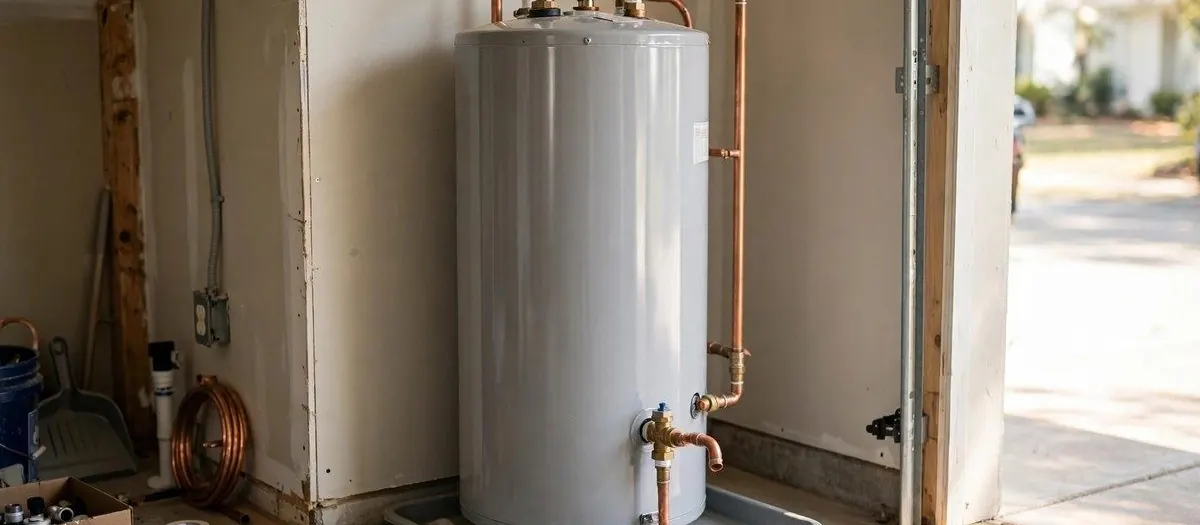
The short answer: leaks and age decide it
Replace a tank water heater when the tank itself leaks. Replace it too when it is well past a decade old and failing in more than one way, or when repair bills approach the cost of a new unit. Repair it when the problem is a single worn part, like a heating element, a thermostat or a gas control, and the tank is otherwise sound.
The tank is the part that cannot be fixed. Once the steel shell rusts through, water escapes from the body of the heater, not from a fitting, and no patch will hold. Everything else on the heater can be swapped.
The rest of this guide shows how to sort your symptoms into one pile or the other. If you want a plumber to look at yours, a water heater repair visit will tell you which pile you are in before anyone talks about a new unit.
Six signs the tank is near the end
One of these alone is a reason to look closer. Two or three together usually mean the unit has earned its retirement.
Water around the base
A puddle under the tank that keeps coming back after you tighten the fittings means the shell is leaking. Fittings drip from the top, a failing tank weeps from the bottom or the seams.
Rust-colored hot water
If only the hot side runs brown and the cold side is clear, the inside of the tank is corroding. Flakes of rust in a bucket of drained water confirm it.
Popping or rumbling
Mineral scale and sediment bake onto the bottom of the tank, and steam bubbles push through it. A little noise is normal. A loud rumble every cycle is a tank working harder than it should.
Lukewarm showers that fade fast
A thick layer of sediment takes up room that used to hold hot water. Flushing helps once. If the tank is old, the layer returns.
A rotten-egg or metallic smell
Odor in hot water only often points to a spent anode rod and bacteria in the tank. A worn anode rod is a repair. A tank that has already corroded is not.
Repeat repairs
A new element in spring, a thermostat in summer and a leaking relief valve in fall add up. The pattern matters more than any single bill.
Look at the data plate on the side of the tank. The serial number usually encodes a manufacture date, and that date is a better guide than the day you bought the house.
Repair or replace: a quick decision table
Use this as a starting point. The plumber on site decides from what the heater actually shows.
| What you see | Usually fixable? | Why |
|---|---|---|
| No hot water on an electric unit, tank dry and cold at the bottom. | Yes, often. | Failed heating element or thermostat, a part swap. |
| Gas unit will not stay lit. | Yes, often. | Thermocouple, pilot assembly or gas control, not the tank. |
| Water dripping from the top pipe connections. | Yes. | Loose or worn fittings, or a supply line that needs replacing. |
| Water seeping from the bottom of the tank. | No. | The shell has failed and the tank must be replaced. |
| Hot water that runs brown, with a tank past a decade. | Rarely. | Interior corrosion is spreading and repair cost rarely pays back. |
| Third repair in a short stretch on an older tank. | Usually not. | Parts are fine, the tank behind them is wearing out. |
Electric and gas heaters fail in different ways. Electric units lose elements and thermostats. Gas units lose igniters, thermocouples and gas controls, and their burn chambers collect scale and debris.
Water on the floor near your heater?
Shut off the cold supply valve on top of the tank, switch off the breaker or turn the gas control to off, then call us and tell us what you see.
How long a tank heater lasts, in general terms
Most tank heaters wear out somewhere around the ten-year mark, give or take a few seasons, and plenty go sooner. That is a general pattern, not a promise. Water chemistry, how much sediment builds up, how hot the tank is set and whether the anode rod was ever checked all change the number.
Failure tends to follow a path. First comes sediment and noise, then slower recovery and shorter showers, then the anode rod is gone and the steel starts to corrode, and finally a slow weep that becomes a leak. Replacing a heater at the weeping stage, before it floods a closet or garage, is far cheaper than cleaning up after one.
Where the heater sits matters
A heater in a garage on a slab can leak for a while with little harm. One in a hall closet, an attic or above finished space can ruin drywall and flooring in an afternoon. If yours is in a spot where a leak does real damage, replace on the early side.
Permits and paperwork for a Greenacres water heater swap
The City of Greenacres building department accepts permit applications only electronically, and the work must be done by a licensed contractor or an exempt owner-builder. For a like-for-like changeout, the City process uses the Palm Beach County Universal Permit Application plus a Water Heater Changeout Form, with the manufacturer specifications attached.
A Notice of Commencement comes into play when the work value is $5,000 or more, which matters mainly if you are changing the type of heater or doing other work at the same time. Inspections are scheduled by 3:00 pm. Tankless and solar heaters go further and require plan check, so a switch of type takes longer than a straight swap.
In practice, ask whoever quotes the job who pulls the permit and who schedules the inspection. For any permit question specific to your address, ask the City of Greenacres building department directly.
What happens on a replacement visit
Shut down and drain
The plumber shuts off the water and power or gas, then drains the old tank to a floor drain or the yard through a hose.
Disconnect and remove
Supply lines, vent or electrical connections come off, and the old tank leaves the house. Hauling it away is part of the job to ask about.
Set and reconnect
The new tank goes on the same footprint or a corrected one. Fittings, shutoff valve, relief discharge and venting or wiring are checked or replaced as needed.
Fill, test and inspect
The tank is filled and purged of air before power or gas comes back. The temperature is set, the connections are checked for drips, and the permit inspection follows.
Repairing now versus replacing on your schedule
A planned replacement beats an emergency one. You choose the day, compare options like a standard tank, a larger tank or a move to tankless, and avoid a cold-shower weekend. An emergency swap is still doable, and our line is answered around the clock, but you have fewer choices.
If your heater is old and healthy, there is no need to rush. Flush it, look for rust at the fittings, and watch for water under the tank. If it is old and leaking, start the replacement now. Our water heater replacement page covers what is involved and how we set the price before work starts.
Cost depends on tank size, fuel type, venting changes, how far the new unit sits from the old one, permit work and whether code updates are needed in the closet or garage. Call for your real number.
If you live in Palm Springs or Lake Worth Beach, the same decision applies. Ask the building department that covers your address which permit forms to use.
Gas smell? Leave first
If you ever smell gas near a gas water heater, leave the building and call the gas utility or 911 before you do anything else. Do not use switches or phones inside.
A replacement and the code
A water heater swap falls under the Florida Building Code, Plumbing, which Florida builds on the International Plumbing Code (IPC), built on the IPC. The installation details matter to any inspection.
Ask the City of Greenacres building department about the changeout form before the old unit comes out.
Questions about replacing a water heater
Dry the tank and the pipes with a rag, then check again in an hour. Drips from the top connections or the relief valve line are usually repairable. Water that seeps from the bottom or side of the tank body means the shell has failed.
Flushing clears sediment and can restore some capacity and quiet the popping. It will not fix a rusted tank, and on a very old unit the disturbance can expose a small leak. If the tank is already weeping, skip the flush and plan a replacement.
Yes. Those are inexpensive parts on electric units, and a plumber can swap them in one visit. It makes sense when the tank is sound. It does not make sense when the tank is leaking or badly rusted.
It depends on how many people use hot water and at what times of day. A household with several showers back to back needs more recovery than a couple. Tell us how you use hot water and we will size it with you.
The City uses a permit process for water heater changeouts, with the Palm Beach County Universal Permit Application and a Water Heater Changeout Form. Ask us who will pull it, and ask the City of Greenacres building department for anything specific to your address.
For a straight swap, usually only for part of the day. The tank needs time to fill and heat. We tell you what to expect when we set the schedule.