
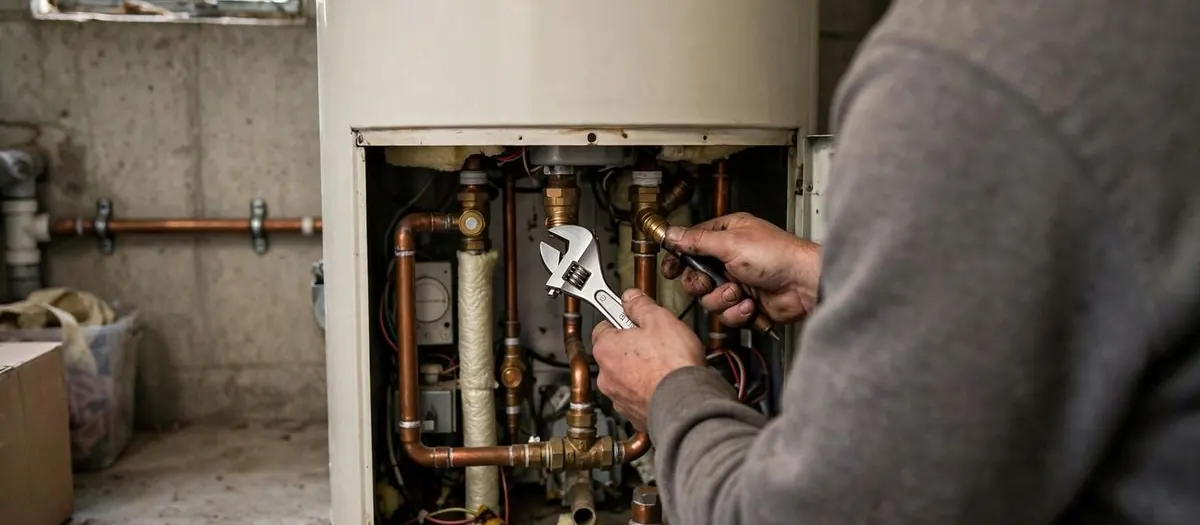
No hot water, or water pooling around the tank?
A dead water heater always seems to quit at the worst moment, and a leaking one can ruin a garage floor before you notice. Our line is answered around the clock, so call us any hour. While you wait, close the cold water valve on the pipe above the tank and switch the heater off (the breaker for an electric or hybrid unit, the gas control knob for a gas unit).
Keep people and pets away from standing water near a plugged-in appliance, and stop running hot taps. If you ever smell gas, skip the knob entirely: leave the house, then call the gas utility or 911 from outside.
What callers describe, and what it usually points to
Most repair calls start with a plain description rather than a part name. These are the patterns we hear most often, with the usual suspect behind each.
Lukewarm or no hot water
On an electric tank this is often a failed lower element or a tripped high-limit switch. On a gas tank it points to a pilot that went out or a dirty burner.
Water around the base
A wet drain pan can mean a loose fitting or a weeping relief valve. A steady drip from the tank body itself usually means the steel shell has rusted through.
Popping or rumbling
Sediment settles on the tank floor, traps steam bubbles and makes the tank knock as it heats. A flush often quiets it, but a heavy crust can shorten the tank's life.
Breaker trips again
A breaker that trips right after you reset it often points to a shorted element or damaged wiring. Do not keep resetting it, since repeated tripping can be a sign of a real fault.
A leak from a fitting is a repair. A leak from the tank body is the end of that tank, and we will say so plainly rather than sell you parts for a lost cause.
Symptoms by water heater type
Electric, gas and hybrid heat pump models fail in different places. Match your unit to the row before you call, and the first conversation gets shorter.
| Symptom | Electric tank | Gas tank | Hybrid (heat pump) |
|---|---|---|---|
| No hot water at all. | Upper element, thermostat or tripped breaker. | Pilot out, thermocouple or gas control valve. | Tripped breaker, error code, or unit stuck in a backup mode. |
| Warm but not hot. | Failed lower element or low thermostat setting. | Sediment on the tank floor or weak burner flame. | Heat pump stage struggling, condensate drain blocked. |
| Water on the floor. | Element gasket, relief valve or tank shell. | Relief valve, fittings or tank shell. | Condensate line, fittings or tank shell. |
| Rotten egg smell. | Anode rod reacting with the water. | Anode rod reacting with the water. | Anode rod reacting with the water. |
| Loud knocking. | Sediment boiling under elements. | Sediment under the burner. | Sediment, or fan and compressor noise. |
Gas water heater: pilot, ignition and venting
A gas unit that will not stay lit usually has a worn thermocouple, a dirty pilot assembly or a failing gas control valve. People often tell us the pilot went out, or that pressing the ignition button does nothing. Relighting is simple in theory, but a pilot that keeps dying is a symptom, and the cause matters.
We also check the flue and draft on every gas repair, because a blocked or backdrafting vent sends combustion gases into the house. If you smell gas at any point, leave the building and call the gas utility or 911. Do not flip switches or hunt for the leak yourself.
Safety first on any gas call
We will not relight or adjust a gas appliance when you have reported a gas odor until the gas utility has cleared the house. That order protects you, and it is not negotiable.
Water heater down tonight?
Our phone line is open all night. Tell us the type, the symptom and whether anything is leaking, and we will line up a same-day visit when one is available.
Electric and hybrid heaters: elements, thermostats and breakers
A standard electric tank has two heating elements and two thermostats stacked behind small access panels. The upper element carries the first heat, and the lower one does most of the work afterward. When one fails, you typically get short, lukewarm showers instead of a total outage, which is why many homes live with the problem for weeks.
Hybrid units add a heat pump on top, which makes the diagnosis different. They carry error codes, a condensate drain that can clog and an electric backup mode. Some callers ask whether we work on hybrids at all, and the answer is yes, with a diagnosis first and a clear price before any parts go in.
- Thermostat set too low or reset trip button popped.
- Element tests open or shorted to the tank.
- Wiring discolored at the terminals.
- Condensate drain on a hybrid blocked with slime.
- Breaker undersized or weakened by repeated tripping.
The anode rod is the cheap part that protects the expensive part
Inside every steel tank hangs a sacrificial anode rod that corrodes in place of the tank wall. Once it is eaten away, the tank itself starts to rust. Swapping the rod early is a modest job, and one callers ask about directly, while waiting until the tank leaks means the rod no longer matters.
Ask us to inspect the rod during a flush if your tank is getting older, since a rod that is mostly bare steel has done its job.
Repair or replace: a quick decision table
Age and location of the damage decide most cases. Use this table as a starting point, then call so we can look at the real unit. If the answer is replace, the replacement page explains what happens next.
| What we find | Usually repair | Usually replace |
|---|---|---|
| Leak at a fitting or relief valve. | Yes, if the tank body is dry. | Only if the tank is also failing. |
| Leak from the tank shell. | No. | Yes. |
| Bad element, thermostat or thermocouple. | Yes, on a sound tank. | If the tank is far past a normal service life. |
| Heavy sediment and constant noise. | Flush may help. | If flushing does not fix it and the unit is old. |
| Repeated breakdowns in a short span. | Maybe one more. | Often, since repairs keep adding up. |
What shapes the cost of a water heater repair
Repair bills swing widely because the fault might be a ten minute reset or a failed control valve. We give you a clear price before work starts, and it reflects these factors.
What insurance may and may not cover
A sudden failure may be treated differently from slow, long-term leakage, and policies differ. Check your policy, call your insurer and take photos of the damage before anything is moved.
We cannot quote a number without seeing the unit, so call for your real number and we will walk you through it.
Tank maintenance that cuts down on repeat calls
Most homeowners can check the temperature setting, look at the drain pan and test the relief valve lever without tools. A yearly flush clears sediment, which also helps electric elements last longer. If your tank is on a Lake Worth Road side street or out toward Jog Road, the age of the home does not change the routine.
Palm Beach County Water Utilities uses chloramine as its disinfectant and switches to free chlorine briefly twice a year. If the water suddenly smells different after one of those switches, that is a utility event, so ask PBCWUD before assuming your heater is at fault. When a unit is simply past saving, our installation page covers the planned route, and the tankless page covers the other option.
Repairs, relief valves and the code
Water heater work is covered by the Florida Building Code, Plumbing, which Florida builds on the International Plumbing Code (IPC), built on the IPC. The temperature and pressure relief valve is a safety part, so we treat a dripping one as a repair to take seriously and not a nuisance.
A like-for-like swap in Greenacres has its own permit forms, covered on the water heater replacement page. A simple part repair is a different matter, so ask the building department if you are unsure.
Water heater repair questions from Greenacres homeowners
Yes. Our phone line is answered around the clock, and for a leaking tank or a unit that has failed completely we try to line up a same-day appointment when one is available. Shut off the cold supply valve and the power or gas control first, then call.
Sediment collects on the tank floor and traps water beneath it, which flashes to steam and pops as the tank heats. A flush often reduces it. A thick crust on an older tank may mean replacement is the better call.
Leave the breaker off and call. Repeated tripping often points to a shorted element or damaged wiring, and forcing the breaker back on can make it worse.
If you smell gas, leave the building and call the gas utility or 911 first. If there is no odor, a dying pilot often means a worn thermocouple or dirty pilot assembly, and we can diagnose it.
Yes, we diagnose hybrid units, including error codes, condensate drain problems and backup electric mode issues. We will explain the likely fault and the price before work starts.
A leak from a fitting or relief valve is usually a repair. A leak from the tank body means replacement. The table on this page and our replacement service cover how that decision goes.
It depends on your policy and on whether the failure was sudden or gradual. Call your insurer, take photos of the damage and keep the failed parts if you can.