
When patching stops making sense
A repipe means replacing the water supply lines that run from the main shutoff to every faucet, toilet, appliance and hose bib. It does not usually include the drain lines, which carry waste out of the house. People think about it after the third or fourth leak in a short time, or when a plumber finds that the rest of the pipe looks as bad as the piece that failed.
If you can't tell yet whether the pipes are past saving, call us and tell us what the pipes are doing. A leak might be one tired fitting and not a pipe problem at all.
Signs the supply lines are wearing out
No single sign decides it, but several together are a strong hint.
Pinhole leaks
Tiny weeping spots, green crust on copper, or damp patches on drywall. When they appear in more than one spot, the pipe wall is thinning everywhere.
Brown or rusty water
Water that runs discolored for a minute after sitting overnight can mean corroding steel pipe inside the walls.
Low water pressure
If pressure is weak at several fixtures and the main valve is fully open, mineral scale or rust may be narrowing the pipe.
Repeat repairs
A pipe that needs a patch every few months is telling you the material is at the end of its life.
Stains and bubbling paint
Ceiling spots, warped baseboards or a musty smell can point to a slow leak inside a wall.
Noisy pipes
Banging, whistling or a high-pitched hum when you run water can come from restricted or loose pipe runs.
Pipe materials compared
We talk through the options for your home. This is the general trade-off for each.
| Material | Strengths | Trade-offs |
|---|---|---|
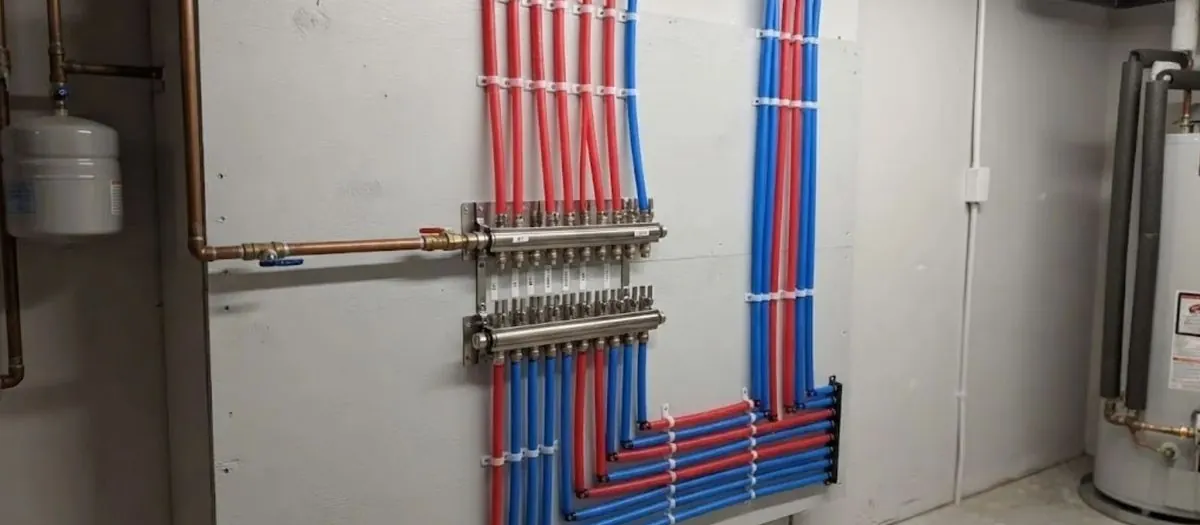
| PEX (flexible plastic) | Bends around corners so fewer walls are opened, resists corrosion, quick to install. | Not for sunlight, so it must be covered outdoors, and fittings need correct crimps or clamps. |
| Copper. | Long track record, handles heat well, no UV problems. | Higher material cost, and it can pit or corrode in some water conditions. |
| CPVC (rigid plastic) | Lower material cost, good for hot and cold, does not rust. | Can turn brittle with age or heat and crack at joints. |
Which one fits depends on the house, the water, how much access you have, and what you want to spend. We lay out the choices before any pipe is cut.
Older homes and the pipes that fail first
Two materials come up again and again in older houses. Galvanized steel rusts from the inside, narrowing the pipe until pressure drops and the water turns brown. Polybutylene, a gray plastic pipe used in many homes from roughly the late 1970s through the mid 1990s, is known to fail at fittings, and plumbers commonly recommend replacing it.
We do not know what is behind your walls until we look, so we do not assume. If your home was built or remodeled in those decades and has never been repiped, ask us to check the main entry and a couple of accessible runs.
Not sure if it's a leak or a repipe?
Describe what you see and we will tell you honestly what the next step should be.
Whole-house or partial repipe?
Not every house needs everything replaced.
Partial repipe makes sense when
- The trouble is limited to one bathroom, the kitchen or one wing.
- Part of the house was already repiped or built with newer pipe.
- A single failed run can be isolated and replaced.
- You want to spread the work out across more than one project.
Whole-house repipe makes sense when
- Leaks are showing up in several places.
- The house still has galvanized or polybutylene supply lines.
- Pressure is weak everywhere and the water runs discolored.
- You are already opening walls for a remodel.
Permits and who may do the work
In Greenacres, permit applications are accepted only electronically, and the work has to be done by a licensed contractor or an exempt owner-builder. Ask the City of Greenacres building department what applies to your house before you agree to a schedule.
You can protect yourself by checking a contractor's Certificate of Competency through the Palm Beach County licensed contractor search at pbc.gov/pzb and confirming current insurance. Be wary of ads with no license number, large upfront payments or an oral-only contract, and remember that a Business Tax Receipt is not a license.
What living through a repipe looks like
Walk-through and plan
We look at the main entry, the wall and attic access, the fixtures, and decide where the new lines will run and where the walls must be opened.
Water off, access holes
We shut off the water for part of the day and cut small openings in drywall at key points. Move furniture away from those areas.
New lines, tests, reconnection
New pipe is run, pressure tested, and connected to fixtures and the water heater. Taps come back on when the lines pass.
Patch and cleanup
Access holes are closed up. Expect the finish painting to be on your list, and ask what is included in the price.
Plan for a day or more without water at some fixtures, and arrange showers and laundry around it. A typical house is a multi-day project, depending on size and access.
What a repipe costs: the factors
You get a clear price before work starts. Several things set it.
What insurance may and may not cover
Insurance may cover water damage from a sudden pipe failure but usually does not pay for replacing pipes that wore out over time. Policies vary, so ask your insurer before work starts.
Call for your real number after we look at the house.
Hidden leaks and bursts, and where repiping fits
A sudden failure is a different situation. If a pipe has burst, shut off the main and see our burst pipe repair page. If you suspect a slow leak but cannot see it, leak detection can tell you whether it is one pipe or many before you commit to a repipe.
Repiping and the permit process
A repipe is governed by the Florida Building Code, Plumbing, which Florida builds on the International Plumbing Code (IPC), built on the IPC. It involves new supply lines, so ask whether it needs a permit and inspection.
In Greenacres, permit applications are accepted only electronically, and work must be done by a licensed contractor or an exempt owner-builder. Verify your contractor before you sign.
Repiping questions
Several pinhole leaks, rusty or brown water, weak pressure at many fixtures, or repeat repairs are common signs. A plumber can look at the main entry and accessible runs to judge the condition.
Each has trade-offs. PEX is flexible and fast to install, copper has a long history and handles heat, and CPVC costs less but can get brittle with age. The right choice depends on your house.
Yes. Both are commonly replaced in older homes, and we can check what you have before recommending anything.
Permit needs depend on the scope, so ask first. Greenacres accepts permit applications electronically only, and the work must be done by a licensed contractor or exempt owner-builder. Ask the City of Greenacres building department about your address.
Usually yes, but expect the water to be off for parts of each day and some dust from the access holes. Many families plan showers and laundry elsewhere on those days.
It depends on the size of the house and how easy it is to reach the pipes. A small partial job may be done in a day, and a whole-house project often takes longer.