
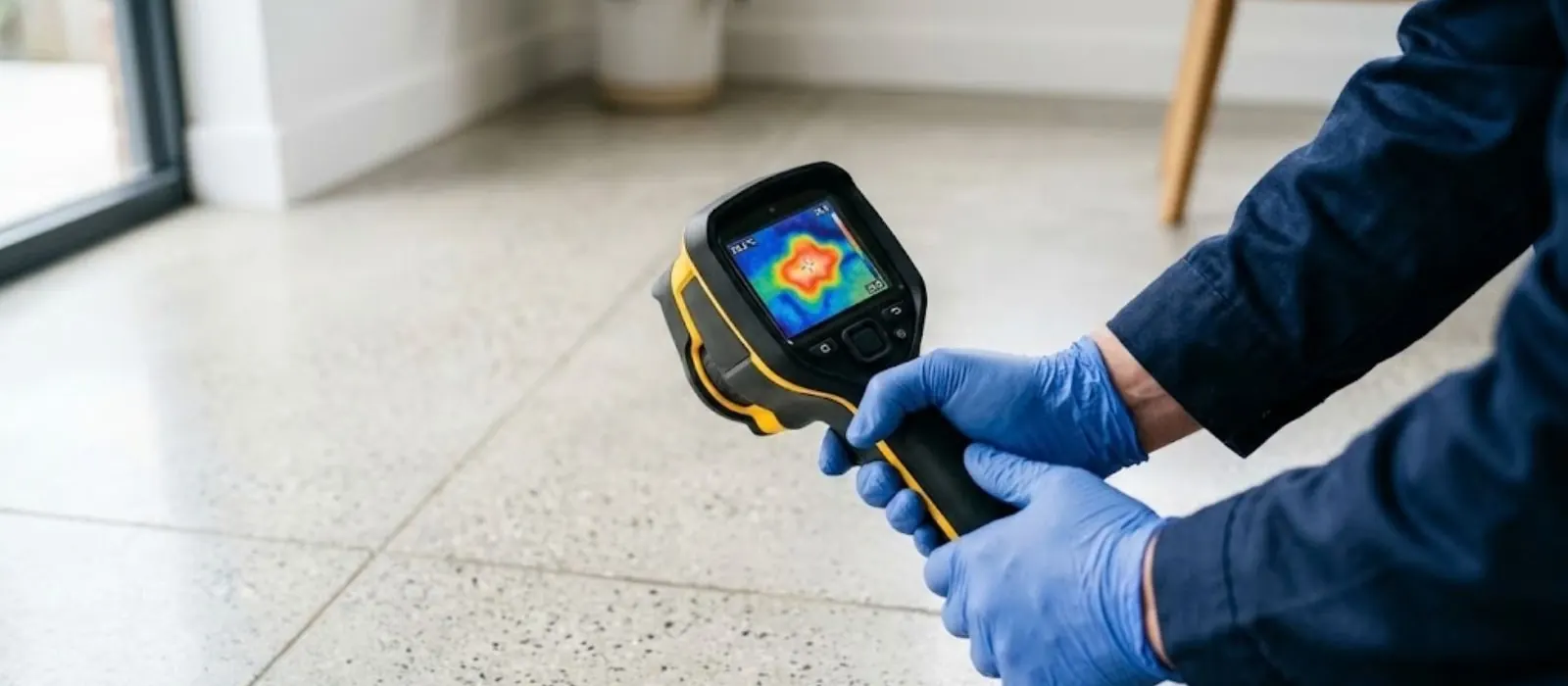
Signs the leak is under your floor
Many Florida homes are built on a concrete slab with pipes running in or under it. A leak there is out of sight, but it leaves evidence.
Hot spot on the floor
A patch of tile or wood that feels warm underfoot often means a hot water line is leaking beneath it.
Sound of running water
You hear a hiss or trickle with every faucet and appliance off. Put your ear near the floor in a quiet room.
Rising water bill
Usage climbs and you cannot explain it. The meter turns with everything shut off.
Damp or lifting flooring
Carpet that feels wet, tile grout that darkens, wood that cups, or baseboards that swell along one wall.
Low hot water pressure
A hot line leaking under the slab can reduce pressure at the water heater side while cold flow stays normal.
Cracks or wet spot outside
Wet soil along the foundation, or a puddle against the house where nothing explains it.
What to do while you wait for us
If water is coming up through the floor, shut off the main valve, and call our 24/7 line. Our line is answered around the clock, and we offer same-day appointments when available. Keep power off in rooms where water is standing on the floor.
Lift rugs and furniture legs out of the water, and take photos of the wet area before you mop. If the water heater is being starved or the leak is on the hot side, switch off the heater at its breaker so the elements are not running without a full tank.
Water coming up through the floor?
Call us. Our line is answered around the clock, and we book same-day appointments when available.
Confirming a slab leak before anything is cut
Callers often say a bill went up or a part of the floor feels warm, and they want to know if it is under the slab. We confirm that first. A pressure test checks whether the lines hold, and closing the house valve at the meter tells us whether the loss is inside or outside.
From there we pinpoint with listening and thermal methods. The goal is a spot repair or a reroute that opens as little floor as possible. A guess that opens the wrong tile costs you twice. For the broader search process see leak detection.
Your repair options under a slab
There are three common answers, and which one fits depends on what we find.
| Option | What it involves | Best fit |
|---|---|---|
| Spot repair. | Break the concrete at the pinpointed spot, cut out the failed section, replace it, close the floor. | One leak on a line that is otherwise sound. |
| Reroute. | Abandon the leaking line under the slab and run a new one through walls or the attic. | A line with more than one failure or one that is hard to reach. |
| Repipe. | Replace the affected lines or the whole house supply, see repiping | Widespread pitting or repeated leaks on the same system. |
A reroute avoids reopening the same floor later. A spot repair is quicker and costs less now. We show you the leak and the pipe condition so you can pick.
What a concrete break-in actually involves
Protect and mark
We clear the area, cover nearby floors, and mark the cut line from the pinpoint.
Cut and remove
We saw-cut the flooring and slab, remove the concrete in pieces, and expose the pipe. Dust control and a wet-vac help contain the mess.
Repair or replace the pipe
The failed section is cut out and a new piece is joined in. We pressure test before anything is closed.
Patch the slab
The opening is refilled with concrete. Flooring replacement is a separate job and not part of this visit unless we agree on it.
What drives the cost of a slab leak repair
What insurance may and may not cover
Policies handle slab leaks in very different ways. Some cover the damage the water causes but not the pipe itself. Some cover the access cost, such as breaking and patching the slab, and some exclude it. Check your policy, call your insurer, and document the wet floors and meter readings.
Call for your real number. We explain the options and give a clear price before work starts.
Slab repairs and the code
Rerouting or replacing lines after a slab leak falls under the Florida Building Code, Plumbing, which Florida builds on the International Plumbing Code (IPC). The IPC governs the new pipe, its supports and its connections.
Breaking a slab and rerouting piping is not a casual job. Ask the City of Greenacres building department about permits, and confirm your contractor holds a license before signing.
Slab leak questions
Yes. Our line is answered around the clock. If water is coming up through a floor, close the main valve and call. We book the earliest available appointment, same day when we can.
Warm flooring, running-water sounds with everything off, a meter that turns when fixtures are closed and damp spots along walls all point to one. A pressure test and a pinpoint visit confirm it.
For a spot repair, yes, in a small area. A reroute avoids the slab by running new pipe overhead. We explain both before work starts.
Often, yes. If the line is otherwise sound, a spot repair may be enough. If it is corroding, we discuss repiping.
We check by closing the house valve and watching the meter. If the meter keeps moving, the leak is on the yard side and falls under water service line repair.
That depends on your insurance and agreement. Flooring restoration is separate work. Check your policy and ask your insurer what applies.
Usually, if you shut off the water when not using it and watch for damage. Moisture under flooring can grow mold and damage materials, so do not wait long.