
Test your tap before you buy any equipment
A softener fixes hardness, a carbon filter fixes taste and odor, and reverse osmosis fixes dissolved solids at one tap. Buying the wrong one wastes money, so the first step is knowing what is in your water. We do not state a hardness figure for Greenacres, because the Palm Beach County Water Utilities Department report does not publish one.
Use a home test kit or a lab test, or ask PBCWUD what it can share for your address. Once you have numbers for hardness, chlorine or chloramine and total dissolved solids, the choice gets simple.
Which system matches which symptom
Match what you see and taste to the right equipment. A test confirms the pick.
| What you notice | Likely fit | What to confirm first |
|---|---|---|
| White crust on fixtures, spotty glass, scale in kettles. | Water softener. | Hardness reading from a test. |
| Chlorine or chemical taste and smell. | Carbon filter, whole house or under sink. | Which disinfectant your supply uses and when it changes. |
| Cloudy or gritty water. | Sediment pre-filter. | Whether it is the water or old pipes. |
| Drinking water taste at one tap. | Under-sink reverse osmosis. | Total dissolved solids reading. |
| Orange or rust staining. | Iron filter or pipe check. | Whether the source is the supply or corroded plumbing. |
| Scale damaging a water heater. | Softener or scale control upstream. | Hardness reading. |
What the PBCWUD report tells us, and what it does not
Palm Beach County Water Utilities places Greenacres in its Eastern service area, supplied from the Biscayne Aquifer by wells about 150 feet deep. The treatment it describes includes lime softening and ion exchange, nanofiltration and reverse osmosis. The report publishes no hardness figure.
So the utility has already treated some of the minerals before the water reaches your meter. That is a reason to test before installing a softener, since you may not need one.
Chloramine and the twice-yearly switch matter for filter choice
The utility uses chloramine as its disinfectant, and temporarily switches to free chlorine twice a year. Chloramine is harder for basic carbon to remove than free chlorine, so a filter that works well during one phase may perform differently in the other.
If you want a whole-house filter, ask about carbon media suited to chloramine and plan for periodic changes. Taste changes after a switch are a utility event, so ask PBCWUD before assuming your equipment is failing.
Have test results and need a plan?
Call us with your numbers and we will talk through softener, filter and RO options and set a clear price.
What to do with your test results
Read the results against what you actually see at home.
Low hardness
Skip the softener. A filter or RO may solve the real complaint.
High hardness
A softener sized to your household protects fixtures and heaters.
Taste or odor complaints
A carbon filter at the main or an under-sink unit is the usual answer.
High dissolved solids
RO at the kitchen tap handles drinking and cooking water.
Bring the report when you call. It changes what we recommend.
Installing and servicing the equipment
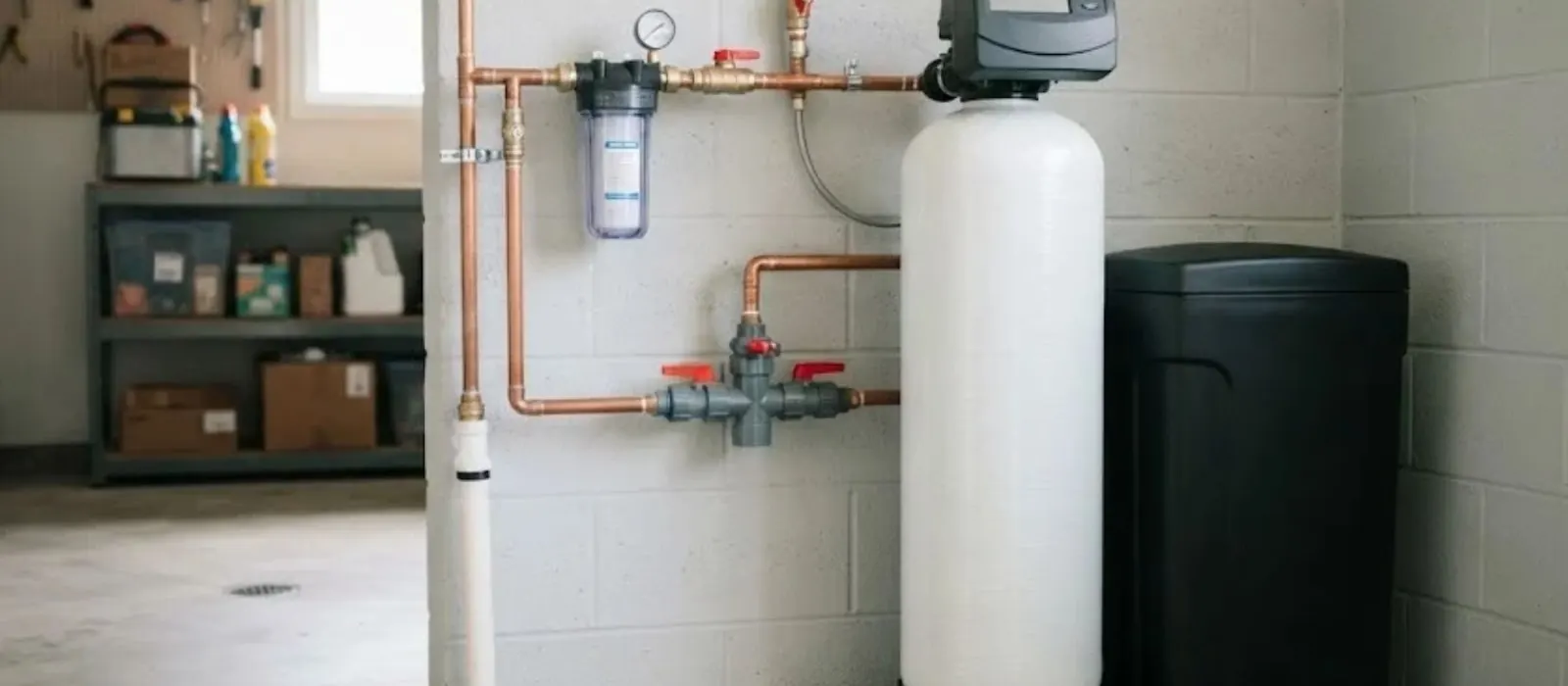
A whole-house system sits near where the main line enters the house, with a bypass valve, a drain connection and an electrical outlet for a softener. An under-sink RO unit needs a small drain saddle and a faucet. We install both and service existing softeners that have valve problems or overflow.
Some callers ask about brine tank problems, valves that will not reset and units that stopped regenerating. We diagnose those, and we also work on the plumbing around the equipment. If your system is hooked into a heater loop, see our water heater installation page.
What affects the cost of water treatment
The equipment and the plumbing around it set the price. We give a clear price before work starts.
What insurance may and may not cover
Water treatment equipment is typically an elective upgrade. If a leak from equipment damages the home, check your policy and call your insurer.
Call for your real number once you have a test result.
Tying treatment to the rest of your plumbing
Scale and sediment can shorten the life of a heater, so treatment and a water heater repair or tankless water heater plan often go together. If your tap water shows brown staining, the cause may be old pipes, and a repiping assessment helps.
Whole-house work also touches the main line, so a good time to discuss it is during other plumbing visits.
Treatment equipment and the code
A softener or filter ties into the home's supply and drain, so the installation follows the Florida Building Code, Plumbing, which Florida builds on the International Plumbing Code (IPC), built on the IPC. Testing your tap comes first, and the plumbing comes after.
The local water system publishes its treatment details in a yearly water quality report. Ask Palm Beach County Water Utilities about your address before you choose equipment.
Softener and filter questions
We do not state a figure because the PBCWUD report does not publish a hardness number. Test your tap or ask PBCWUD.
Only if a test shows hardness that is causing problems. Test first.
Palm Beach County Water Utilities Department places Greenacres in its Eastern service area.
Yes. Chloramine is harder for basic carbon to remove, and the utility switches to free chlorine twice a year. Ask about media suited to your setup.
Yes, we install RO at the kitchen sink.
Yes, including valve and regeneration problems.