
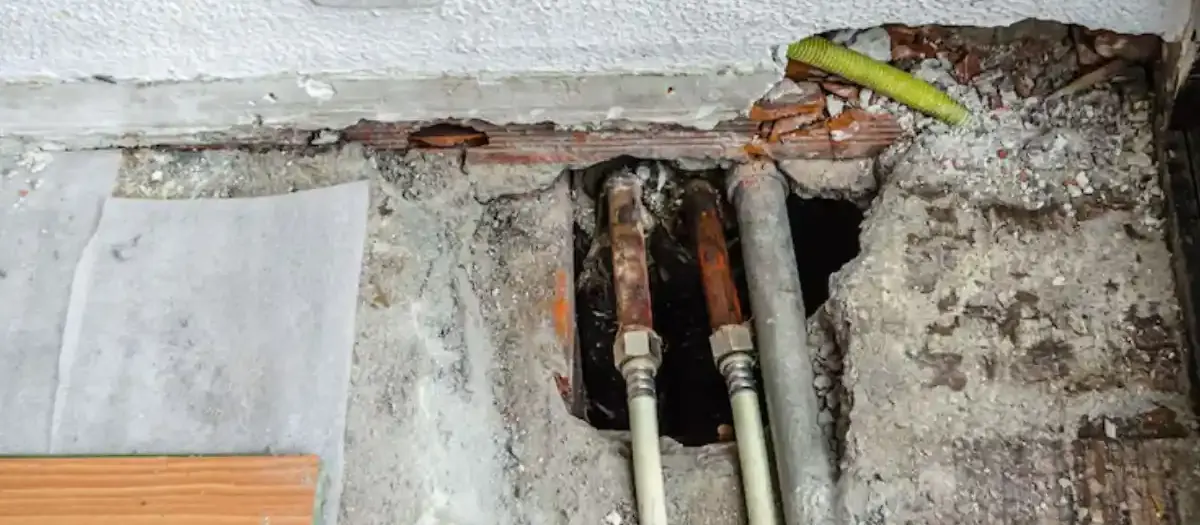
A quick picture of a slab-on-grade house
A slab-on-grade home sits on a poured concrete pad instead of over a crawl space or basement. Many homes built on slabs in Florida have their drain lines cast into or run beneath that pad, because gravity drains need a downhill path from every sink, tub and toilet. Depending on the age and design of the house, some supply lines may be there too, though many homes run them overhead or through walls.
That is a general picture, not a promise about your house. The only way to know what is under yours is to look at plans, ask a plumber to trace the lines, or run a camera in the drains.
What often runs beneath the floor
Exactly what is down there varies by house. These are the pieces most often found in or under a slab, and each can fail in its own way.
Drain lines from bathrooms
Tubs, showers and toilets often tie into drain lines that run just below the floor. A cracked or sagging line can leak into the soil without showing on the surface.
Kitchen and laundry drains
These branches usually join the main under the slab. Grease and lint build up here, and a slow drain can be a first hint.
The main building drain
Every branch meets in a single line leaving the house toward the city sewer or a septic system. A problem here shows up in many fixtures at once.
Cleanouts and traps
Cleanout access points let a plumber push a cable or camera into the line. Knowing where yours are saves time and saves the floor.
Some supply lines
In some homes, hot and cold lines run beneath the slab to reach the kitchen or a bath. Your plumber can confirm for your house by tracing the lines.
Sleeves and penetrations
Pipes pass through the concrete where a sleeve or a foam wrap should protect them. If it is missing or worn, the pipe may rub against the concrete as it expands and contracts.
Why slab problems hide so well
Concrete, tile and carpet sit between you and the pipe, so a leak in a buried line can run for a long time before anything shows. A drain leak sends wastewater into the soil under the house. A supply leak pushes pressurized water through the same path and eventually finds the lowest or weakest point.
Because of that, the first sign is often indirect. People describe a high water bill, a floor that feels warm in one spot, the sound of running water when everything is off, or a musty smell. Each of these has other possible causes, which is why a proper test beats a guess.
- A water meter that keeps moving when every fixture is off.
- A warm spot on tile or a floor that feels damp.
- Hissing or running water heard through the floor at night.
- Cracks in tile, baseboards that swell, or mildew near a wall base.
Seeing one of these signs?
Do not wait for a stain to spread. Call us and tell us what you notice and where.
How plumbers trace a buried line
Locating a problem under a slab is detective work. Several tools get used together, and each answers a different question.
| Method | What it tells you | What it cannot tell you |
|---|---|---|
| Water meter test. | Whether water is leaking somewhere after the meter. | Which pipe or where. |
| Pressure test on isolated lines. | Which supply run is losing pressure. | The exact spot under the concrete. |
| Acoustic listening. | The sound of a leak, to narrow the location. | Leaks that make little noise. |
| Thermal imaging. | Warm water traces in the floor, for hot lines. | Cold-water leaks, which may not show. |
| Sewer camera. | The condition and path of drain lines, with depth and location. | Pressure problems in supply lines. |
A good tech combines these. A single reading is rarely enough to justify cutting concrete, so ask what evidence points to the spot before any break-in begins.
What a break-in is and what living with one looks like
A break-in is the planned cut through the slab that gives a plumber access to a buried pipe. The crew marks the area, protects the surrounding floor, cuts the concrete, repairs the pipe and patches the slab. It is invasive, but it is targeted, and it is often done in a day.
Plan for dust, noise and the loss of the flooring over the cut. Move furniture and anything fragile away from the area, and ask whether the contractor handles floor restoration or leaves that to you. Our guide to slab leak repair explains the process, and the separate decision guide on repair methods compares the alternatives.
Your options for checking a drain line
For drain lines, a sewer inspection puts a camera into the pipe so the plumber can see cracks, roots, offsets and low spots without opening the floor. It also shows how far the line runs and at what depth, which helps decide whether a spot repair or a larger fix makes sense.
What to do if you suspect something under the floor
Read the meter
Shut off every fixture and appliance. Note the meter reading, wait an hour or two, and read it again. A change means water is going somewhere.
Check the obvious first
Rule out a running toilet, a dripping faucet and an irrigation leak. These are far more common than a buried line and much cheaper to fix.
Photograph and note
Take photos of stains, cracks or wet spots with dates, and write down when you first noticed them. This helps a plumber and your insurer.
Get the line traced
Ask for pressure testing, listening and a camera as needed. Do not agree to a break-in until the location has been confirmed with more than one reading.
Yards, drainage and permits in Greenacres
Greenacres is drained by the Lake Worth Drainage District and the South Florida Water Management District, and single-family lots must retain the first inch of runoff, according to the City's plan documents. That matters when you see wet ground near the house, because standing water in the yard may be rain, irrigation or a leaking pipe, and it takes a test to tell them apart.
If your repair needs a permit, ask the City of Greenacres building department. It takes applications only electronically, requires a licensed contractor or an exempt owner-builder, and schedules inspections by 3:00 pm. Do not assume the rules, and do not hire anyone who will not show a license you can verify.
Questions for neighbors across town lines
People ask us whether the same slab issues apply in nearby towns. In general, yes, if the house is on a slab. Our Royal Palm Beach service page and Lake Worth Beach coverage explain how we handle calls in those areas.
What is buried and what the code says
Piping under a slab was installed under the Florida Building Code, Plumbing, which Florida builds on the International Plumbing Code (IPC) or its predecessors, based on the IPC. Any repair brings new work under the current rules.
Ask the City of Greenacres building department whether a break-in or reroute needs a permit.
Slab plumbing: your questions
Often some of it is, especially drain lines. Whether supply lines are also beneath depends on the home. A plumber can trace the lines and tell you for your house.
No crawl space or basement, a ground-level floor, and an exterior wall that meets the soil at about the floor line are common signs. Home plans or a plumber's visit can confirm it.
We do not quote figures without seeing the job. The cost depends on the depth of the pipe, the size of the cut and the flooring above it. Call for your real number.
Yes. Meter tests, pressure tests, listening gear, thermal imaging and a sewer camera can locate most problems before any concrete is cut.
They might, depending on the material and condition. A camera inspection of the drains and a pressure test of the supply lines tell you where yours stand.
No. It can be rain, irrigation or drainage, and the city's lots must retain the first inch of runoff. A meter test and a camera run help separate a leak from ordinary yard water.