
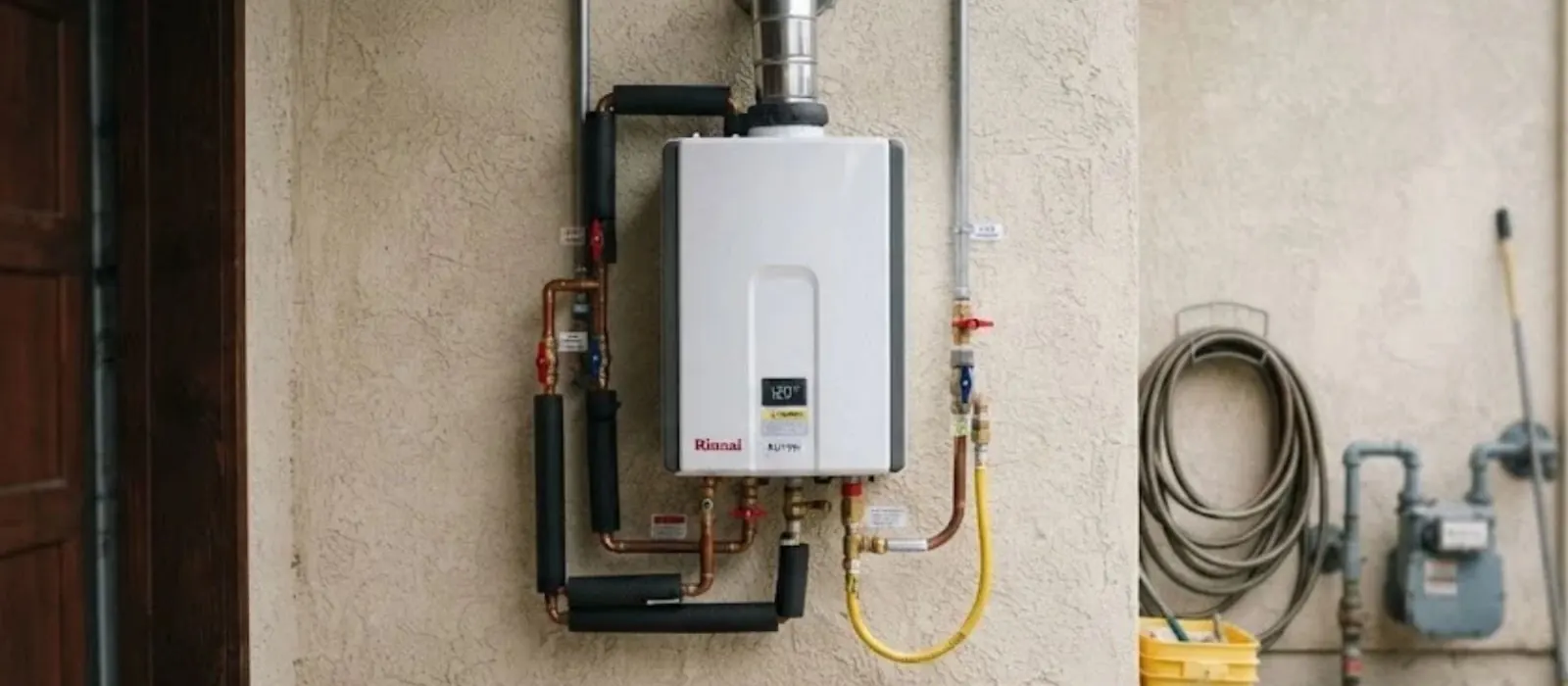
Better for some homes, worse for others
A tankless water heater is better if you want hot water that does not run out, you are short on floor space, and you are willing to pay more up front for a unit that heats on demand. It is not better if your priority is the lowest install cost, if your gas line or electrical panel would need heavy upgrades, or if you will skip the upkeep.
A tank heater stores 40 to 80 gallons and keeps it hot all day. A tankless unit heats water only while a tap is open, so there is no tank to run dry. The trade is that the unit has to deliver a big jump in temperature in a few seconds, and that takes serious power or gas flow.
Our tankless water heater page covers the models and service we handle. This post is the decision guide.
Tankless vs tank, side by side
These are general patterns. Your house and your habits tilt the result.
| Factor | Tank heater | Tankless heater |
|---|---|---|
| Up-front cost. | Lower for the unit and the install. | Higher, and install work can add to it. |
| Hot water supply. | Limited to the tank, then a wait to recover. | Continuous, up to the unit's flow limit. |
| Floor space. | Needs a closet or garage corner. | Wall-mounted, takes little floor. |
| Standby loss. | Tank keeps water hot all day. | No stored water to keep hot. |
| Upkeep. | Occasional flush, anode rod check. | Periodic descaling flush, filter screen cleaning. |
| Several taps at once. | Fine until the tank runs out. | Can struggle if demand passes the flow limit. |
| If something fails. | Simple parts, wide familiarity. | More electronics, more specialized repair. |
Neither design is magic. A tankless unit sized too small gives lukewarm showers when the dishwasher and two bathrooms run together, and a tank sized too small runs out by the third shower.
Who tends to benefit and who does not
Tankless tends to suit
- Households with long back-to-back shower use that empties a tank.
- Homes where the closet or garage space is tight.
- Owners planning to stay long enough to recover the higher cost.
- Homes where the gas or electrical supply can handle the load without major changes.
A tank may suit better
- Buyers who want the lowest install cost and the simplest repairs.
- Small households with spread-out hot water use.
- Homes where a gas line upgrade or panel upgrade would be a big added cost.
- Rental properties where easy, familiar service matters most.
Gas or electric tankless: the real differences
Gas tankless units heat quickly and can deliver a larger flow, but they need adequate gas supply, proper venting and a condensate path on high-efficiency models. If your existing gas line is sized for a small tank heater, the pipe may need to be larger, and that adds cost.
Electric tankless units avoid venting and gas lines, but they draw a lot of current. Whole-house electric models can require heavy circuits, and an older panel may not have the room. A licensed electrician and a plumber may both be involved.
Either way, the unit has to match your incoming water temperature and the flow you want. We size by counting fixtures that run together, not by square footage.
Where gas safety fits in
If you smell gas at any time, leave the building and call the gas utility or 911 first. Do not turn switches on or off. After that, call a plumber to check the appliance and the connections.
Weighing a switch from tank to tankless?
Call us and describe your house, your fuel and how many people use hot water at once. We will tell you whether it looks like a good fit.
What upkeep a tankless heater needs
Clean the inlet screen
Most units have a small filter at the cold inlet. Debris collects there and cuts flow. Shut the isolation valves and rinse it.
Flush the heat exchanger
Mineral scale builds inside the exchanger and reduces heat transfer. A descaling flush with a pump, hoses and a mild acid solution clears it.
Check the vent and condensate
On gas units, make sure the vent is clear and any condensate line drains. A clogged condensate trap can shut a unit down.
Watch the error codes
Display codes point to flame, flow or temperature faults. Write the code down before you call. It speeds up the diagnosis.
Plan checks and water treatment in Greenacres
In Greenacres, tankless and solar water heaters require plan check through the City building department, which is a step beyond the like-for-like permit paperwork used for a standard tank changeout. Permit applications are accepted only electronically, work must be done by a licensed contractor or an exempt owner-builder, and inspections are scheduled by 3:00 pm. Build that plan check into your timeline, and ask the City of Greenacres building department about specifics for your address.
Water quality affects maintenance, so it is worth knowing what comes from the tap. Palm Beach County Water Utilities describes Greenacres as part of its Eastern service area, supplied from the Biscayne Aquifer, with treatment that includes lime softening or ion exchange, nanofiltration and reverse osmosis. The disinfectant is chloramine, with a temporary switch to free chlorine twice a year.
The utility's report does not publish a hardness number, so we do not state one. If you want to know how much scale your unit will see, test your tap and ask PBCWUD. The result tells you how often a descaling flush is worth doing.
Cost factors and what to ask before you buy
Several things set the price of a tankless job. The unit's capacity matters, along with gas or electric supply upgrades, venting and the distance from the old heater to the new location. Permit and plan check time and removal of the old tank count too. A like-for-like tank swap is a simpler job and usually costs less.
Ask any installer how the unit was sized, whether gas line or panel changes are included, who handles the permit, and what the flushing schedule should be. Our water heater installation service walks through those points before work begins, and we set a clear price before work starts.
If you are on the fence, ask about a high-efficiency tank as well. It is a legitimate middle road, and it avoids the plan check.
Nearby towns, same question
The same comparison applies in Wellington and Royal Palm Beach, and a home with several bathrooms is the case where on-demand heat gets the most attention. Your local building department process may differ from Greenacres, so ask it before you plan.
Tankless and the code
Tankless installations follow the Florida Building Code, Plumbing, which Florida builds on the International Plumbing Code (IPC), which rests on the IPC. If the swap changes fuel or venting, mention it when you ask about permits.
Greenacres says tankless units need plan review, so allow time for that step.
Tankless questions answered
It gives hot water for as long as the tap runs, but only up to the unit's flow limit. If two showers and a dishwasher run at once, a small unit may not keep up. Sizing is the key.
It can lower standby losses, but the higher purchase and install cost often takes a long time to recover. Whether it pays off depends on your usage, fuel cost and how long you stay in the house.
It depends on your water and your usage. Hard or scale-prone water means more frequent flushing. Test your tap and ask PBCWUD about your supply, then ask your installer for a schedule.
Sometimes. Gas units need venting and enough gas flow, and electric units need a large circuit. We check the existing space, supply and venting before suggesting a location.
Yes. Greenacres requires plan check for tankless units, which adds a step before the permit is issued. A like-for-like tank swap follows a simpler changeout form process.
Chloramine is the disinfectant used by Palm Beach County Water Utilities. Ask the utility or the unit's maker whether anything in your setup needs attention, and test your tap if scale is your concern.