
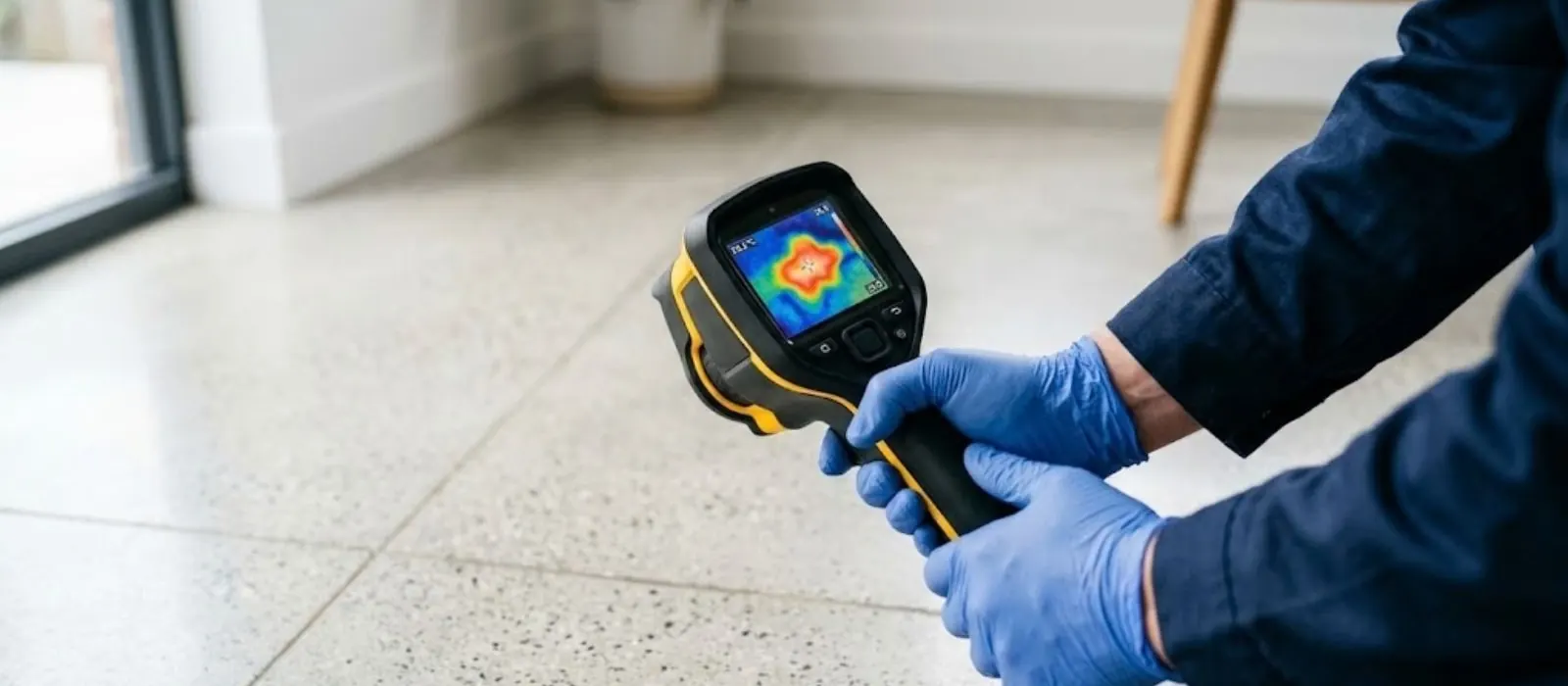
The short answer: it sees temperature, not water
An infrared camera cannot see water. It records surface temperature and paints it as a color map, so a wet patch shows up only when it is warmer or cooler than the dry material around it. That is why a thermal image on its own never proves a leak. It tells a technician where to look and which tool to pick up next.
Evaporation is the main reason wet drywall reads cooler than dry drywall. A leaking hot line can do the opposite and glow warm through a wall. In both cases the picture is a lead, and a moisture meter or a pressure test has to confirm it before anyone cuts into a wall.
If you suspect a leak right now, start with the cheap checks in the leak detection process: read the meter, look at the water heater and toilets, and watch for stains. A thermal scan is one step in that chain, not the first or last.
Where thermal imaging helps and where it does not
The camera only reads what reaches the surface it is pointed at. Material thickness, finish and room temperature decide how useful the image is.
| Situation | How useful is infrared | What it is usually paired with |
|---|---|---|
| Water stain on a ceiling below a bathroom. | Often very useful, wet drywall reads cooler. | Pin or pinless moisture meter to confirm the edges. |
| Damp spot on an interior wall. | Useful if the wall is thin drywall over a hollow cavity. | Moisture meter, then a small inspection opening. |
| Leak in a concrete block exterior wall. | Limited, the block mass hides small temperature swings. | Moisture meter, hose test, pressure test of the line. |
| Soft or warm spot on a tile floor. | Useful when a hot line runs near the surface. | Meter test, then acoustic listening. |
| Line buried deep under a thick slab. | Poor on its own, the concrete blocks the signal. | Acoustic listening, pressure test, isolation of line sections. |
| Leak in the yard between meter and house. | Weak, soil and sun skew the picture. | Meter test, listening on valves, targeted digging. |
Notice the pattern. The thinner and more hollow the surface, the better the picture. The thicker and denser the surface, the less you can trust it.
Why a thick slab defeats the camera
Many Florida homes, including those across Palm Springs and nearby towns, sit on a concrete slab with supply or drain lines running through or under it. Concrete holds heat and spreads it slowly, so a small warm or cool zone from a leak gets smoothed out long before it reaches the floor you are scanning.
A slab leak on a hot line may show as a warm tile patch, and that is a real clue. A slab leak on a cold line usually shows nothing at all. That is where listening gear and line isolation do the real work, as described on our slab leak repair page.
Floor coverings matter too. Carpet, pad and wood flooring insulate the surface, which weakens the image further. A scan that finds nothing over a thick slab is not an all clear, only a sign the camera was the wrong tool for that spot.
How a leak hunt usually runs from first look to confirmed spot
Read the meter with everything off
Shut off every fixture and appliance, then watch the small leak indicator on the meter. If it keeps spinning or ticking, water is moving somewhere on your side of the meter.
Walk the house with a moisture meter
Meter readings on drywall, baseboards and cabinet floors map the wet zone in numbers instead of colors. Readings are compared against a dry reference spot on the same material.
Scan with the thermal camera
The camera sweeps ceilings and walls to catch temperature patterns the meter missed, especially above a stain or along a wall that shares a bathroom.
Confirm with sound or pressure
Acoustic listening picks up the hiss of pressurized water at a pipe. A pressure test on an isolated section shows whether that section holds, which narrows the search before any cutting.
Wet ceiling or a meter that will not stop?
Our line is answered around the clock. Call us and describe where the water or the stain is.
What to expect during a scan visit
Before and during the visit
A visit is mostly measuring and ruling things out, so a little preparation saves time.
- Clear access to the water heater closet, the main shutoff and any attic hatch.
- Note when the stain appeared and whether it grows after showers or after rain.
- Do not run the air conditioning hard right before a ceiling scan, since a cold surface can mask a pattern.
- Keep the dishwasher, washer and irrigation off so the meter test is clean.
- Take photos of stains and the meter reading so changes are easy to compare later.
Expect the technician to explain what the camera shows and what it does not. A good visit ends with a confirmed spot or a clear list of the next tests, not a guess.
Greenacres: the utility meter and boil notices
The City of Greenacres long-range plan points to Palm Beach County Water Utilities (PBCWUD) for water, so many homes have a PBCWUD meter at the edge of the lot. Look for the meter box near the curb, lift the lid, and find the low flow indicator. Turn off everything inside, then check whether the indicator moves over a few minutes. Movement means water is escaping after the meter.
Boil water notices follow main breaks, and Greenacres has seen one. In March 2024 a contractor struck a PBCWUD main on the south side of Lake Worth Road near Charleston Street, and affected households were told to boil water.
During a notice, follow the utility's instructions for drinking and cooking. The meter test itself is still fine to run, but a sudden pressure change after a repair can make a meter look odd for a short while, so repeat the test once pressure settles.
Some Greenacres properties are still on septic until centralized service arrives. That has no effect on a supply leak test, but a soggy yard patch near a septic tank is a drain issue, not a supply leak, so mention it when you call.
Why one tool is never enough
Each method has a blind spot. Thermal imaging misses leaks in dense material. Moisture meters only read what they touch. Listening gear struggles on plastic lines and in noisy areas. Pressure tests show that a leak exists without saying where.
Used together they cover each other, whether the house is in Greenacres or across the line in Lake Worth Beach. The camera narrows the room, the meter marks the wet boundary, the listening step points to the pipe, and the pressure test confirms which line is failing. That sequence is also what keeps wall and floor openings small.
If the leak turns out to be on the buried line between the meter and the house, the repair moves to the water service line side of the job, which is dug rather than opened from inside. Catching that early avoids tearing into walls that were never the problem.
What you can check yourself and what needs equipment
Homeowner checks
- Meter indicator test with everything off.
- Toilet dye test with a few drops of food coloring in the tank.
- Looking under sinks and behind the water heater.
- Checking ceilings for rings that grow.
- Comparing this month's bill with last month's.
Needs equipment
- Thermal scan of ceilings and walls.
- Moisture mapping behind finishes.
- Acoustic listening on pipes and valves.
- Pressure testing of isolated line sections.
- Locating a line under a slab or in a yard.
Detection is not repair
A thermal camera only locates a problem. The repair that follows falls under the Florida Building Code, Plumbing, which Florida builds on the International Plumbing Code (IPC), built on the IPC.
If the fix involves opening a wall or slab, ask the City of Greenacres building department about permits.
Questions people ask about infrared leak detection
No. It reads surface temperature only. A wet area can show up as a cooler patch because of evaporation, but that is a clue that a moisture meter must confirm.
Rarely on its own. A hot line near the surface can warm a tile patch, but a thick slab smooths out most signals. Slab leaks are usually found with listening gear and pressure testing.
A scan is non-invasive, since the camera only looks at the surface. Cutting is a separate step, and the goal of the tests is to keep any opening as small as possible.
That does not rule out a leak. It may mean the leak is too deep, too small or behind dense material. The meter test and listening tools are the next step.
Turn off all water use inside and out, open the meter box, and watch the low flow indicator for a few minutes. If it moves, water is leaking somewhere after the meter. Take a photo of the reading before and after a short wait.
You can, but repeat it once pressure has settled after the repair work. Follow the utility's notice for drinking, cooking and ice, and call the utility if you have questions about the notice itself.