
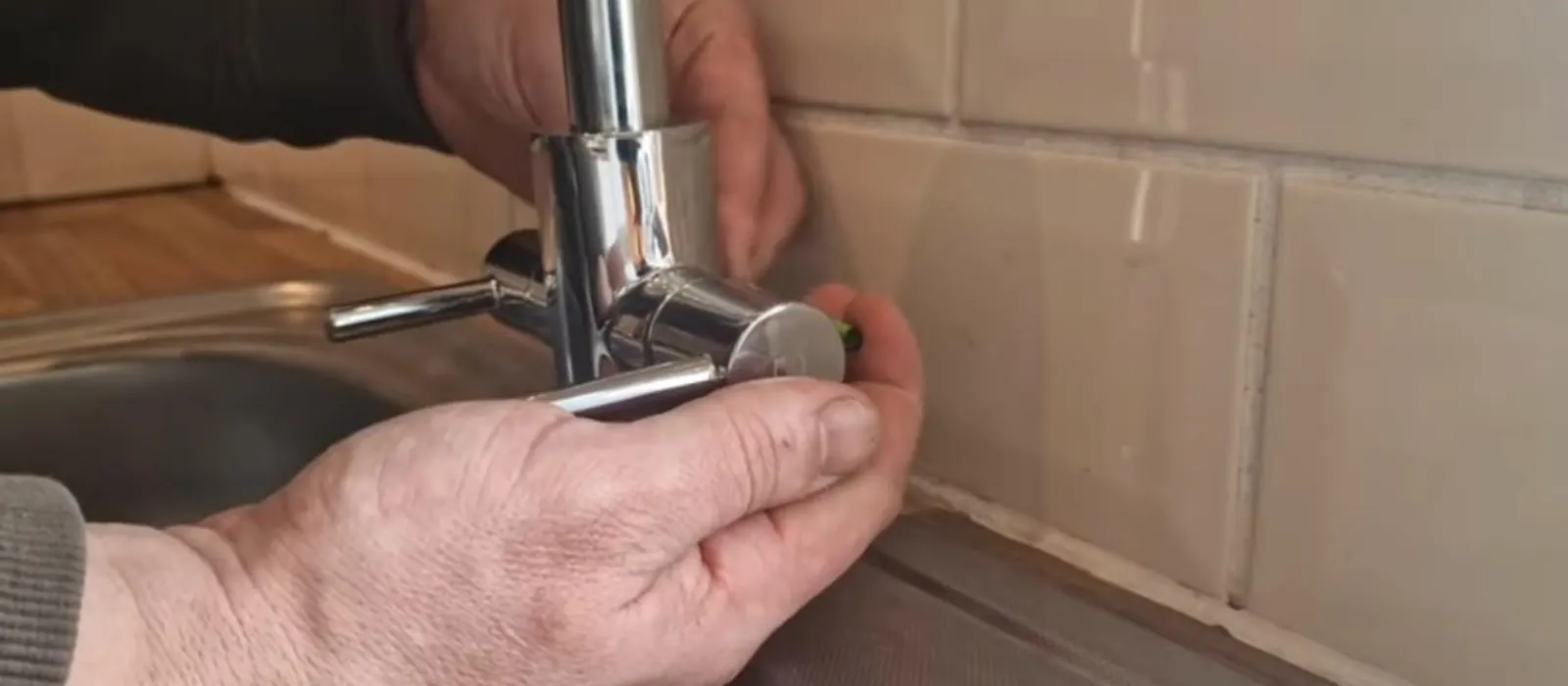
The short answer: a worn seal is letting water past
A bathroom faucet drips because something inside it no longer seals when the handle is off. In a compression faucet that is a rubber washer pressed against a brass seat. In a cartridge or ball faucet it is a cartridge, an O-ring or a spring and seal pair. In all of them, a small amount of water is slipping through a gap that should be shut.
The good news is that these parts cost little and the repair usually takes under an hour once the water is off. The catch is that you have to know which design you own before you buy anything, because a washer kit will not fit a cartridge faucet.
Six places the drip can start
Where the water appears tells you which part to suspect. Watch the spout for a minute with the handle fully closed, then look at the base and the handle.
Worn cartridge
A single-handle faucet with a cartridge drips from the spout when the cartridge face or its seals wear. It may also run a thin stream when the handle sits in the cold position.
Cracked O-ring
Water pooling around the base of the spout or under the handle usually points to a flattened O-ring. The faucet still shuts off, but it weeps where parts swivel.
Pitted valve seat
In a compression faucet the brass seat can corrode, so even a new washer cannot close against it. The drip returns within days of a repair.
Hardened washer
A rubber washer that has gone stiff or flat no longer grips. Two-handle faucets drip from the spout on the side whose handle you turn off hardest.
Clogged aerator
The aerator is the screen at the spout tip. It does not cause a drip, but scale on it can spray water sideways and make a good faucet look faulty.
Loose or worn stem
A handle that wobbles, or one you must crank tight to stop the flow, often has a worn stem or a loose packing nut behind it.
Most bathroom faucets in homes built over the last few decades are cartridge or ceramic disc types. Older two-handle sets are more often compression. Check the handle: if you must turn it several rotations to shut off, it is almost certainly compression.
What to replace, by faucet type
Match the faucet design to the part before you shop. Taking the old part to the store is the surest way to match it.
| Faucet type | How to recognize it | Part that usually fails | Typical fix |
|---|---|---|---|
| Compression (two handle) | Handles turn several times, soft stop at the end. | Rubber washer or seat. | Replace the washer, then dress or replace the seat. |
| Cartridge (single or two handle) | Smooth quarter turn or lever, round stem inside. | Cartridge or its O-rings. | Pull the retaining clip, swap the cartridge. |
| Ceramic disc. | Heavy, smooth quarter turn. | Disc cylinder or its seals. | Replace the cylinder and seals as a set. |
| Ball (older single handle) | Rounded cap under a lever. | Springs, seats and cam seal. | Use a rebuild kit that matches the make. |
| Wall or tub-style set. | Valves inside the wall. | Valve cartridge or stem. | Shut off water first, then open the trim carefully. |
If you cannot tell which design you have, take photos of the handle, the base and the underside of the sink. They help whoever you ask for advice.
A careful repair for a typical cartridge faucet
Close the water and plug the drain
Turn the two angle stops under the sink clockwise until snug. Open the faucet to bleed pressure, and stuff a rag or a drain plug in the sink so a dropped screw cannot vanish.
Remove the handle and trim
Pry off the cap, then take out the set screw or handle screw. Lift the handle and unscrew the trim ring. Lay the parts in order on a towel.
Pull the cartridge and inspect it
Remove the retaining clip or nut and lift the cartridge straight up. Look for cracks, scoring and flattened rubber rings, and wipe out the valve body with a damp cloth.
Install a matching part and test slowly
Seat the new cartridge in the same orientation, secure it, and reassemble. Open the angle stops slowly and check for weeping at the base before you leave the area.
Two-handle compression faucets follow the same pattern, but you unscrew the stem and replace the washer and seat. A seat that is rough to the touch may need a seat wrench or a seat dressing tool, which is where many first repairs stall.
Drip persists after you swapped the part?
A damaged valve body or a corroded seat will not hold a new cartridge. Call us and we can sort out the repair or the replacement over the phone.
Repair or replace the faucet
A repair is the sensible choice when the faucet is otherwise sound, parts are easy to find and the finish is intact. Replacement wins when the body is pitted, the finish is flaking, the handle spins loosely on a worn stem, or the faucet has already been rebuilt more than once. At that point you are paying twice for the same problem.
Cost depends on a few things, and we do not quote figures without seeing the fixture. The main factors are the faucet's make and whether parts are still sold, how corroded the supply connections are, whether the angle stops work, and how tight the sink is to reach. Call for your real number once we know what is on the wall.
When replacing is also the time to upgrade
If you are already replacing a bathroom faucet, check the hole spacing of your sink so the new set fits. A three-hole sink needs a widespread or centerset model, while a single-hole sink takes a one-handle faucet.
Our faucet repair team can handle the swap, and if you are adding a new vanity or moving fixtures, a plumbing installation visit covers the supply lines and stops at once. Homeowners in Palm Springs and Royal Palm Beach can reach us for the same work.
What a small drip does to your water bill
A drip does not look like much, but it runs every hour of every day. Over a month a steady drip can add noticeably to your water use, and the cost shows up on the bill without any single obvious leak to point at. That is also why people often discover the drip only when a meter reading looks high.
To check, read your meter, shut off every fixture, wait a few hours, and read again. If the dial moved, you have a leak somewhere, and the bathroom faucet is a good first suspect. We do not give a gallon or dollar figure here because it depends on drip rate and your rates, but the principle is simple: a fixed drip costs less than a ruined vanity cabinet.
- Check under the sink for damp wood, rust on the supply lines and green crust on brass fittings.
- Look at the faucet base for a ring of mineral deposit or a soft, swollen vanity top.
- Shut the angle stops if the drip returns after repair, then call before the cabinet floor rots.
Water and permits for Greenacres homes
Greenacres is in Palm Beach County Water Utilities' Eastern service area, and the utility's 2025 water quality report lists chloramine as the disinfectant, with a temporary switch to free chlorine twice a year. We cannot say whether that affects your faucet parts, so if rubber seals seem to wear quickly, ask the utility how your area is treated.
The utility's report does not publish a hardness figure, so we do not state one. If you see white crust on the aerator or the spout, test your tap with a simple kit, or ask PBCWUD, before you spend money on a softener. A basic faucet swap normally does not need a permit conversation, but if you are unsure, ask the City of Greenacres building department, which takes permit applications only electronically.
Fixture repair and the code
Faucets are fixtures covered by the Florida Building Code, Plumbing, which Florida builds on the International Plumbing Code (IPC), built on the IPC. Replacing a cartridge is maintenance, not new installation.
If you plan to add supply lines or move a sink, ask the building department first.
Bathroom faucet questions we hear
A worn washer, cartridge or O-ring is letting water pass, or the seat behind a compression washer has corroded. Overtightening makes the damage worse because it grinds the seal against the seat.
Often yes, if you can shut the angle stops, identify the faucet type and match the part. Stop and call if the stops will not close, the stem is seized, or the drip returns after the new part goes in.
Not by itself. A drip from the spout can wait a few days. Water spraying from the base, a stop valve that will not shut, or damp cabinet wood is a different story and deserves a faucet repair call soon.
Pitted or flaking finish, a body that weeps at the base, a stem that wobbles, or a model whose parts are no longer sold all point to replacement. Repeated repairs on the same faucet are another sign.
Heat softens and swells rubber seals, and a worn cartridge may seal cold but not hot. It can also point to a failing mixing cartridge in a single-handle faucet.
We cannot say that it does. The utility publishes no hardness figure in its 2025 report, so test your tap for mineral buildup or ask PBCWUD, and look at the aerator for scale before you assume the water is the cause.