
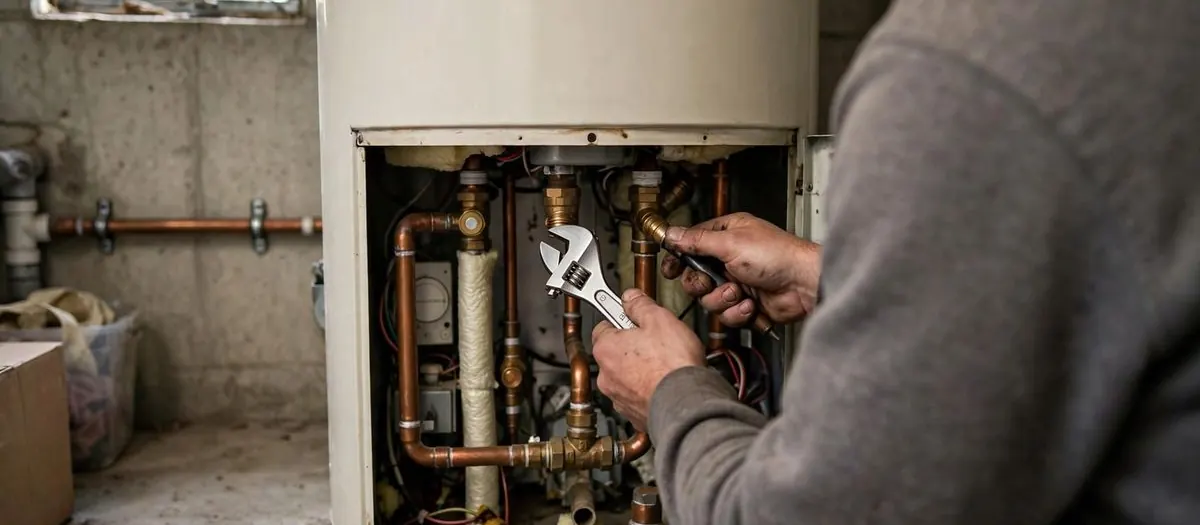
What the rod does inside the tank
The anode rod is a long metal rod, usually magnesium or aluminum, screwed into the top of a tank water heater. It corrodes on purpose. Because it is more reactive than the steel tank, it takes the attack from the water and protects the shell, which is why it is called a sacrificial anode.
When the rod is used up, the water starts working on the tank wall. A heater with a good rod can outlast one with a spent rod by a wide margin. Checking it takes a little time and the right socket, and replacing it costs far less than a new heater.
If you suspect yours is gone or the tank is already leaking, a water heater repair visit can inspect it and tell you whether the tank is worth saving.
How to inspect an anode rod in plain steps
This is a job for someone comfortable with tools. If the tank is old or the rod is stuck, call a plumber instead of forcing it.
Turn off power or gas and the cold supply
Switch off the breaker for an electric unit or set the gas control to off. Close the cold water valve on top of the heater.
Relieve pressure and drain a few gallons
Open a hot tap in the house and drain some water from the tank drain valve so the level drops below the rod's port.
Loosen the rod
The hex head sits on top of the tank. A breaker bar and a 1-1/16 inch socket are common. Use steady force. A rod that will not budge may be seized in the fitting.
Pull it and look
A healthy rod is thick with a little roughness. One that is pencil-thin in places, or shows bare steel wire, is spent. Replace it, then refill the tank and check for leaks before power or gas comes back.
Clearance is the usual obstacle. Some heaters sit under a low ceiling and cannot take a rigid rod. Flexible, segmented rods exist for those spots.
Smell and symptom: anode rod or something else
Rotten-egg odor in hot water is the classic sign people connect to the rod, but it is not the only cause.
| Symptom | Likely link to the rod | What else to check |
|---|---|---|
| Sulfur smell in hot water only. | Possible, the rod can feed bacteria that make the gas. | Tank sediment, water temperature setting, the source water. |
| Sulfur smell in hot and cold. | Unlikely. | The water supply or a drain trap, not the heater. |
| Smell from a drain, not a tap. | No. | A dry or blocked trap, a vent problem, a drain clog. |
| Rust-brown hot water. | Possible if the rod is gone and the tank is corroding. | Old galvanized supply pipe, a failing tank. |
| Popping or rumbling. | No. | Sediment and scale at the bottom of the tank. |
| Slow leak at the bottom. | Too late for the rod. | The tank has failed, see replacement. |
Smell in both hot and cold taps is a water supply or drain question. If a drain is the source, a drain cleaning call is more useful than a new rod.
Smell, rust or noise from your heater?
Describe what you notice and which taps it comes from. Call us and we will tell you where to look first.
Chloramine and water chemistry in Greenacres
Palm Beach County Water Utilities places Greenacres in its Eastern service area, supplied from the Biscayne Aquifer. Its 2025 water quality report describes treatment that includes lime softening or ion exchange, nanofiltration and reverse osmosis. The disinfectant is chloramine, and the utility switches temporarily to free chlorine twice a year.
That is useful background for an anode rod conversation because the water chemistry inside your tank affects how fast the rod is consumed and what bacteria do around it. We do not state a hardness figure because the report does not publish one. Test your tap, and ask PBCWUD about the supply feeding your address.
Bring that information to the plumber who inspects your rod. If you notice a change in smell or taste around the time of a disinfectant switch, mention the timing. It helps separate a utility change from a tank issue.
When replacing the rod is not worth it
A new rod only helps if the tank is still sound. If the heater leaks from the bottom or seams, if rust-colored water has been showing up for a while, or if the tank is well past the ten-year mark with a rod that has not been touched, the shell may already be thin.
Another sign that you are too late is a rod so corroded that it crumbles in your hand or leaves a pile of flakes in the drain water. Even then, checking is not wasted effort. You learn the tank's condition and can plan a water heater replacement on your schedule instead of in a flood.
Cases where a new rod makes sense
A heater a few seasons old with no leaks, mild odor and a rod nearly gone is a good candidate. So is a unit in a home where a leak would do real damage and you want to stretch its life while you plan.
What shapes the cost of an anode rod job
We set a clear price before work starts. Call for your real number.
Neighbors ask us about this too
Owners in Lantana and Lake Worth Beach face the same anode rod question, and each town has its own water system. Your water source differs from Greenacres if you are served by a municipal utility, so ask your own provider about its treatment before comparing notes.
Maintenance versus permitted work
Replacing an anode rod is maintenance on a water heater installed under the Florida Building Code, Plumbing, which Florida builds on the International Plumbing Code (IPC), built on the IPC. It does not change the installation.
If you decide to replace the whole unit instead, a changeout form applies in Greenacres.
Anode rod questions
A look every year or two is a reasonable habit, and more often if your water is aggressive. Test your tap and ask PBCWUD about your supply, then adjust the schedule based on what you find when you pull it.
It can contribute. Some rods feed sulfur-reducing bacteria that produce hydrogen sulfide, which smells like rotten eggs. If the smell is only in hot water, the heater is a suspect. If it is in both hot and cold, look elsewhere.
Sometimes, but it also removes the tank's protection and shortens its life. A better path is a different rod type or a tank flush. Ask a plumber to look at yours first.
Tankless units do not have a storage tank, so they do not use a sacrificial anode rod. They need descaling and filter care instead.
Possibly. Palm Beach County Water Utilities uses chloramine, with a temporary switch to free chlorine twice a year. Ask the utility or your plumber how that might affect your tank, and test your tap if you are unsure.
If you are comfortable with tools, yes. The rod may be stuck, the tank may be hot and a leak after refill is possible. Call a plumber if the tank is old or the rod will not move.